
날짜변경선
日付変更線
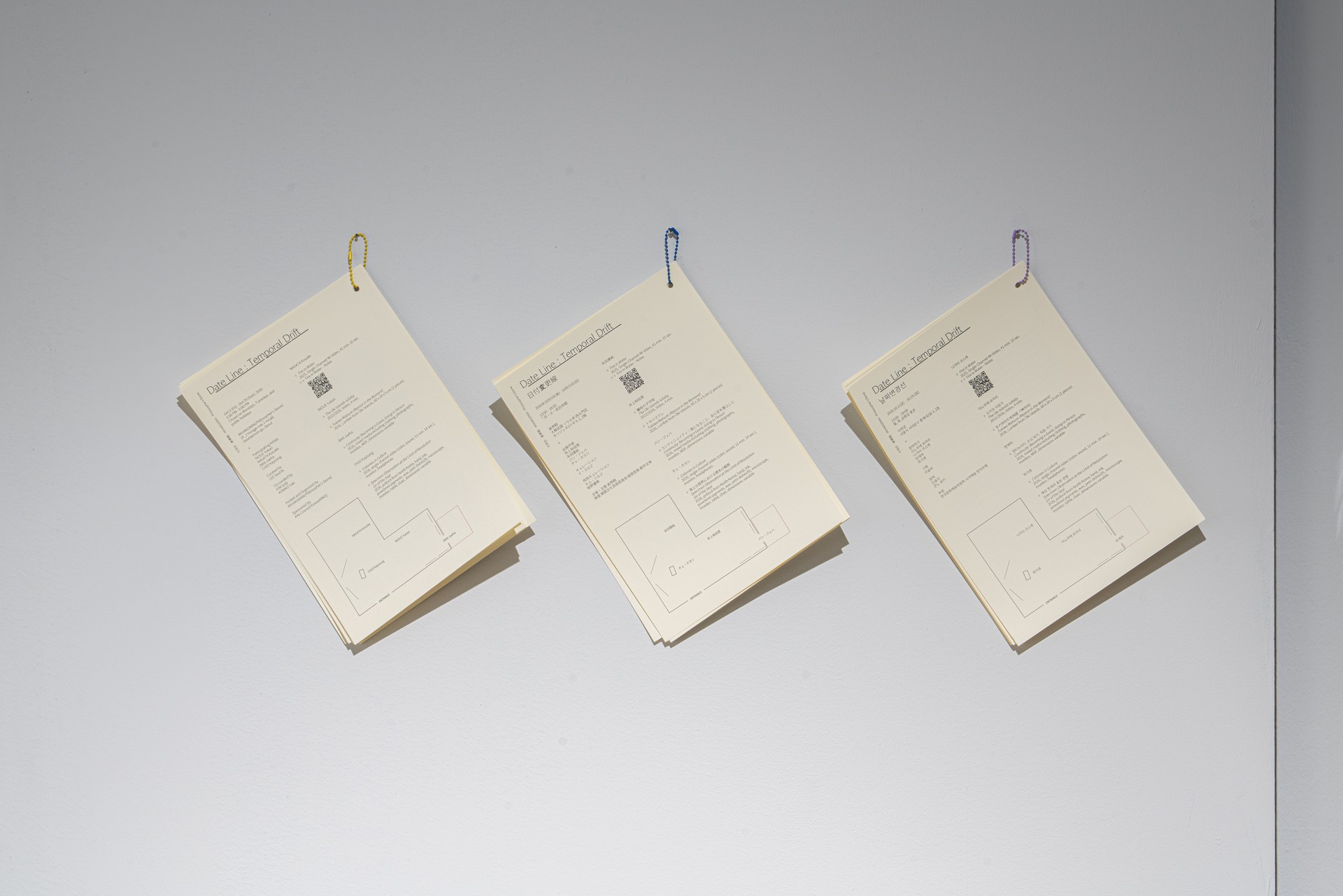
D͟a͟t͟e͟ ͟L͟i͟n͟e͟ ͟:͟ ͟T͟e͟m͟p͟o͟r͟a͟l͟ ͟D͟r͟i͟f͟t͟ ͟͟
Oct 2 (Fri) - Oct 25 (Sun), 2026
1:00 PM - 6:00 PM
Closed on Mondays, Tuesdays, and public holidays
Artist|INOUE Yukari, NAGATA Kosuke, BAN Jaeha, CHOI Kayoung
Curated by|LEE Seul bi
Co-curated by|KIM Solji, KONNO Yuki
Design|genegong(PARK Jiyeon)
Hosted and Organized by|MIHAKGWAN(Philosopher’s Stone)
Sponsored by|Arts Council Korea(ARKO) (Visual Arts Creation Group)
Special thanks to|CHUN Geunsung
Crossing Between Shift and Error
Could there be a more intuitive title than this? A word that instantly explains the concept of “time shift”—something that always puzzled me whenever I took a flight. A word that reveals how the very basic units of perception—time and space—are, in fact, highly relative. Just as the clocks ticking at different speeds in a hotel lobby seem to fragment the same moment in time, the term “International Date Line” symbolizes the division of time. The Date Line is an invisible, imaginary boundary arbitrarily drawn by humans on the Earth’s surface. Winding its way through the middle of the Pacific Ocean along the 180th meridian, this line serves as a dividing point that separates and distinguishes time—yesterday and today, and the past and the future. It is also the source of the most dramatic time difference that can occur between geographically adjacent spaces. Or, it is a peculiar boundary where, even within the same physical space, one side is “yesterday” and the other is “today” relative to this line. This strange boundary—where, the moment you take a single step across it, a day is skipped or you are transported back to time already passed—vividly illustrates the temporal misalignment and asynchrony that occur at a physical point of contact. With this invisible line as our boundary, we become “yesterday” to one another, transforming into “the other,” and—even while living in the same era—experience different layers of time.
Date Line: Temporal Drift features two Korean artists and two Japanese artists. However, the exhibition does not intend to directly expose the political, cultural, and historical time lags between Korea and Japan. The term “nation” used here is not limited to Korea and Japan—two countries that are strangely similar yet so different—but encompasses all that defines boundaries. Transcending the physical distance between nations, the exhibition invokes the “Date Line” as a symbolic threshold to reveal the emotional, historical, and institutional gaps hidden beneath the surface. Despite their relatively close geographical proximity, the modern and contemporary histories of East Asia are intertwined with sensory time lags arising from their distinct historical trajectories and cultural contexts. Thus, some trace the origin of mold found on food brought from afar, questioning its “country of origin,” while others trace the journey of liquor brewed with Korean rice and nuruk to understand how it has continued to circulate to this day, having passed through the very heart of the historical event known as the Japanese colonial period. Or they ask whose language it is that emerges at the point where different nations share the same time, or they experiment with revealing the limitations or cracks in the systems hidden within daily life.
Their work generally begins with positioning themselves as outsiders in unfamiliar places through the act of moving their own bodies. This movement is not limited to the physical act of simply changing spatial coordinates or occupying a geographical location. This is because when the temporal order accumulated over a long period in an individual’s life enters the space of the Other, complex vibrations—such as conflict and consensus, understanding and misunderstanding—arise there.
Thus, the time lag at the heart of this exhibition is not merely a difference in time zones; it signifies the dissonance that arises when the pace of life internalized by an individual through their body collides with the social systems of a foreign land and the historical narratives encountered there. This ambiguous liminality—where one is simultaneously observer and observed—becomes another symbolic meaning of the Date Line. While this ambiguous liminality appears to reveal the fundamental limitations of the outsider, it is not limited to issues of nationality or place of birth. Today, we live in an era where mobility and settlement are more convenient than ever before—an era in which we can establish a residence anywhere and become an outsider anywhere—so a stay in a foreign land can be viewed as an attempt to synchronize one’s senses with the historical layers of the Other across national borders. Thus, the spaces or bodies occupied by these four artists—rather than being reduced to fixed addresses or mere locations—become a “moving land” and a dynamic field that is constantly transformed through the intermingling of fragmented records collected during the research process, the trajectories left by moving bodies, and heterogeneous cultural and emotional codes. Consequently, this exhibition gathers the discrepancies created by time—divided by boundaries—that these moving bodies leave behind as they pass through. The moment we believe a boundary line exists, we are already standing on it, and every time we cross that line, we become slightly different people. All of this occurs on the assumption that an invisible line actually exists. Isn’t that amazing!
Text by LEE Seulbi (Curator, Director at MIHAKGWAN(Philosopher's Stone))
The History of This and That…?: Is It Japanese? Is It Korean?
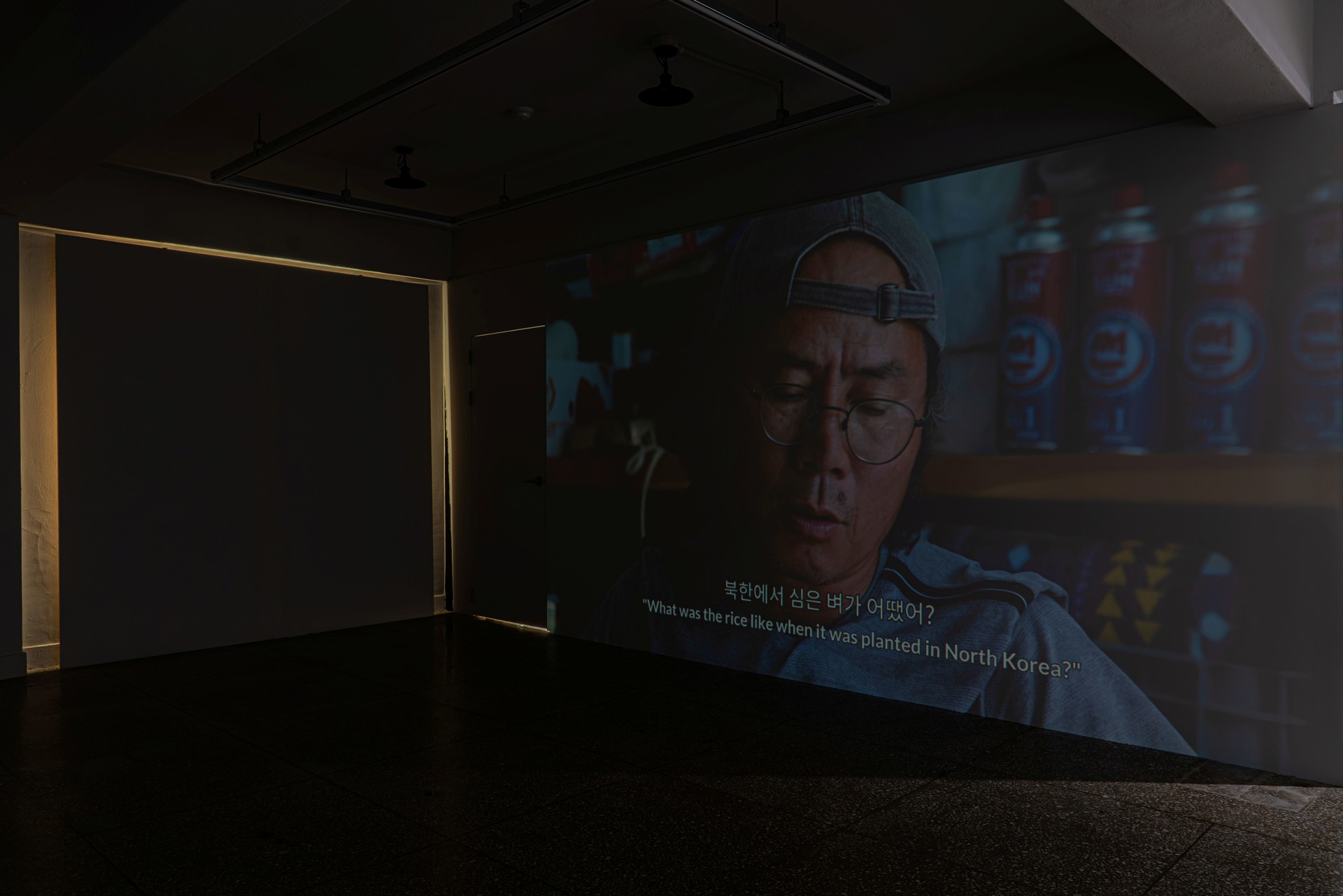
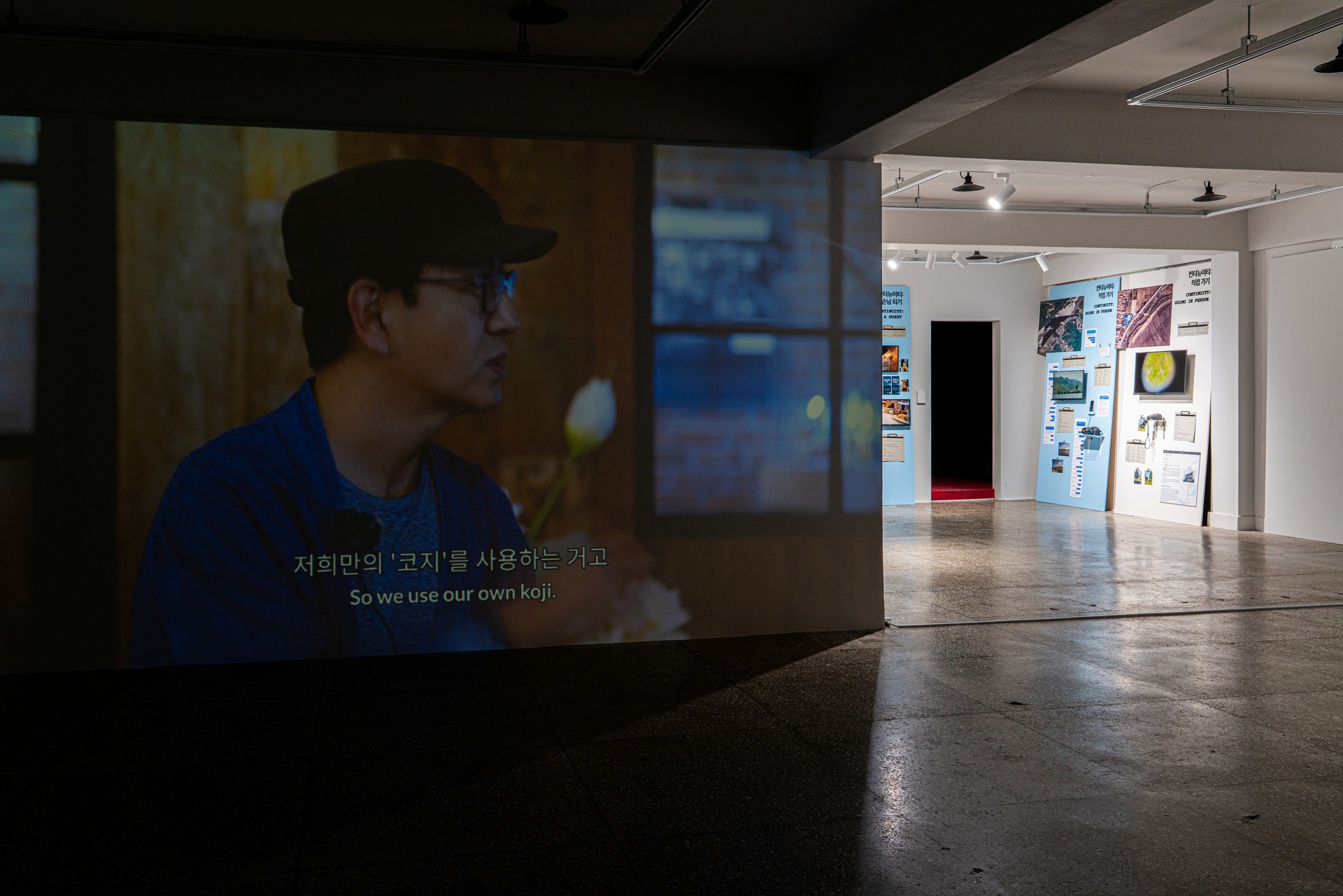
For this exhibition, titled Date Line: Temporal Drift, we have invited two artists based in Japan. These are artists with whom I have been in contact over the past three years. While I had been familiar with NAGATA Kosuke’s exhibitions and works since the late 2010s, I didn’t actually meet him until three years ago—and it wasn’t even in Tokyo, but in Seoul, South Korea. In 2023, I had the opportunity to meet the artist, who was participating in the SeMA Nanji Residency exchange residency program. This led to field research in 2024, during which I visited a farmhouse in Yangpyeong and a brewery in Busan with Kosuke. The findings from this research were presented as the work Fire in Water(2025), exhibited at the Ebisu Film Festival 2025: Docs: Images and Records (Tokyo Metropolitan Museum of Photography, January 31–February 16, 2025). This video work illustrates how the history of alcohol—made in Korea from rice, water, and yeast—was shaped by the institutions of the Japanese colonial period and their lingering remnants (though it actually possesses more complex and diverse layers). In a sense, this marks the official debut in Korea of a work that was first introduced in Japan.
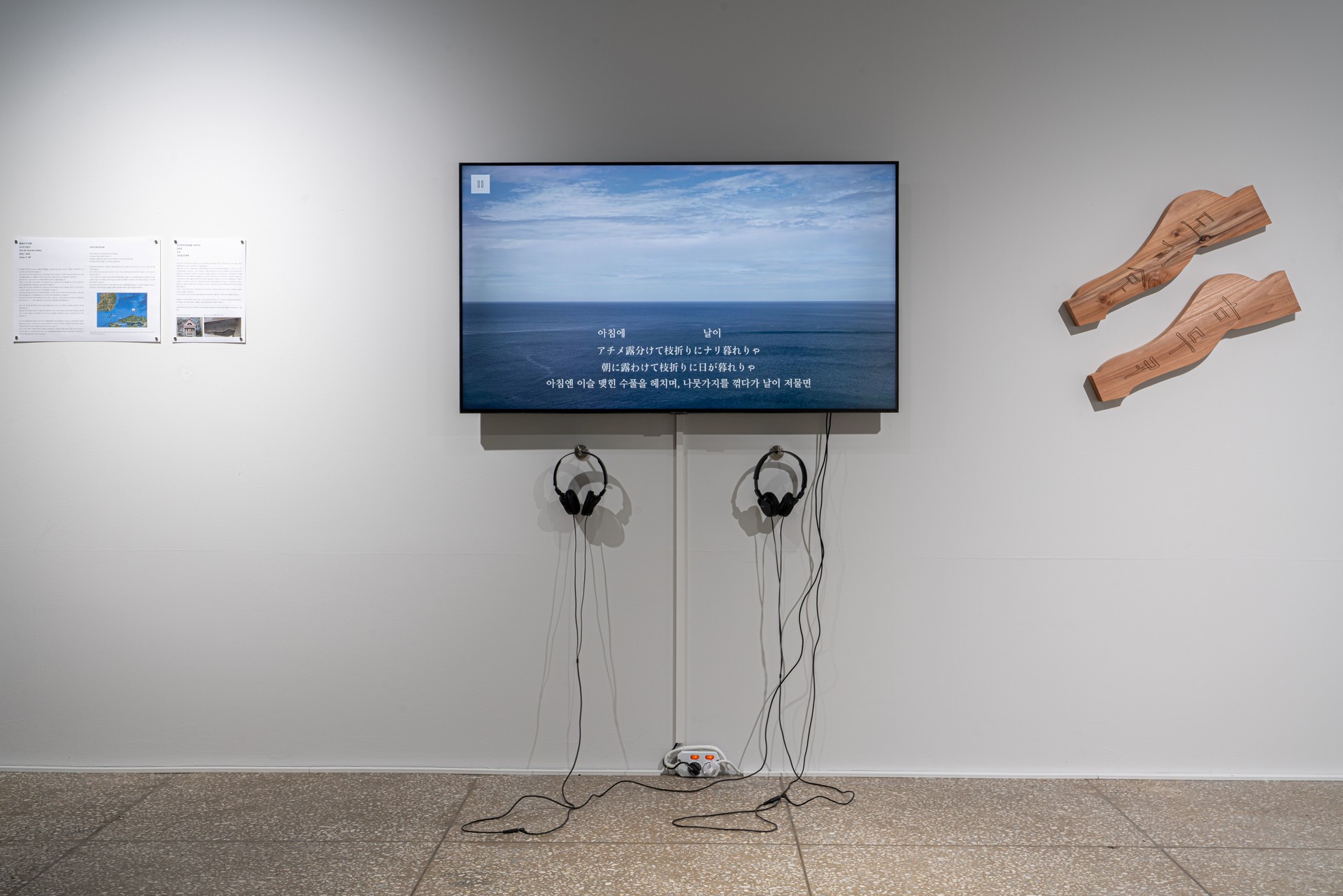
Meanwhile, I met INOUE Yukari in Kyoto, not Tokyo. I became aware of the artist’s interests when she participated in the exhibition Close and Far, Far and Close (The Terminal KYOTO, September 21–October 1, 2024) as a member of the “Japan-Korea Art Correspondence” project, which has been run primarily by artists from Kyoto and Cheongju. That was also the first time I heard her talk about the lullabies of Oki Island. Later, in 2025, I spoke with the artist at her solo exhibition JIN JIYAN AZADÎ: Women, Life, Freedom (A-LAB, February 1–March 30, 2025), held in Amagasaki City, Hyogo Prefecture. This exhibition also featured the video work People Who Are Erased Time and Again (2019/2025), which consists of interviews with Korean women who were victims of the Hiroshima atomic bombing. Set in Hiroshima—where the artist was born and raised—it offered another perspective on postwar Japanese history. This work reveals the history of people marginalized within the framework of Japan as a defeated nation. Similarly, The Oki Islands lullaby (2022/2026), featured in the curated exhibition Date Line: Temporal Drift, deals with the history of Oki Island—a subject rarely encountered in the capital, Tokyo—much like the history of the Korean woman who lived in Hiroshima.
The title Date Line: Temporal Drift traverses the colonial Korean Peninsula, Korea, and the Japanese Empire in Kosuke NAGATA’s work. Similarly, in Yukari INOUE’s work, it traverses from island to island—from the Korean Peninsula to the Oki Islands. Interestingly, there is no time difference between these regions. However, the absence of a time difference does not mean we exist within the same temporal space; that is not the case. Although there is no time difference, there is a reciprocal relationship of influence within it.
Moving back and forth not only between the past and the present but also between objects and non-objects, institutional regulations and deviations, and spoken and written records, the former has influenced the latter, and the latter has influenced the former. If there is a framework called “Japan” operating within this context, one is led to ask: where exactly does “Japan” end? As it changes and is encroached upon depending on the era and cultural background, the boundaries become blurred. In Fire in Water, how far does the category of tradition—as embodied by Jong-kyun—extend? And if it is not tradition, what else falls within Japan’s sphere of influence? In The Oki Islands lullaby, does the Korean language heard originate from the Korean Peninsula, or from Ulleungdo or Jeju Island? If we examine it that way, should we say it is the language of a specific region, or of a specific country? Tokiwa Matsure (Rejoice in the Moment) (2026), created based on the experience of discovering the “Abiru script”—which mimics the shape of Hangul to pass as an ancient Japanese script—on Oki Island, what exactly does it mean to “rejoice in a certain moment”?
The history depicted in Date Line: Temporal Drift delves deeper into Japan and all things Japanese. Just as the history of alcohol was forged through the conceptual and material intersection of Japanese and Korean elements, and just as the words heard in a lullaby—preserved only as lyrics without song—are presumed to be Korean, doubt and inference recur throughout the two artists’ works. What lies at the end of this recurring cycle of doubt and inference? It is likely another history—one that remains undefined within history, or, to put it another way, a history of “etc.” When this “etc.” history is presented through the works, we come to realize that the International Date Line, though invisible, is still there—and that it is drawn differently depending on the era and political stance. When something belongs to—or does not belong to—a certain category, “etc.” leaves behind the diverse textures contained within equivalence, lingering in the ear, on the palate, and in the eye.
Text by KONNO Yuki
The Shape of Lines: Dots, Wavelengths, and
Current time: 12:47 p.m. in Seoul and Tokyo; 11:47 a.m. in Shenyang, China; 11:47 p.m. in Washington, D.C., U.S. Whenever I look at the world clock hanging on the wall of a hotel lobby, or glance at the world clock displayed in a row on my iPhone, I am reminded anew that we—who share the present—are living under different local times and dates. “Roughly” following the times of sunrise and sunset, the International Date Line runs vertically like the stripes on a watermelon. Occasionally, this line changes due to deliberate decisions to widen or narrow the time difference. For example, in 1995, the Pacific island nation of Kiribati moved the International Date Line eastward so that all its islands would share the same date. As a result, the Line Islands, located east of Kiribati, are now five hours ahead of here—making them the first place in the world to welcome the New Year. It’s not where the sun rises earliest, but it is where the day begins first. Players of the mobile game “Pokémon GO” flock to Kiribati to catch newly released Pokémon. There’s a closer example as well. In 2015, North Korea introduced “Pyongyang Time,” setting its clocks 30 minutes behind those of South Korea and Japan. At the time, people commuting from South Korea to the Kaesong Industrial Complex sometimes found themselves effectively living those 30 minutes all over again when crossing the border from one place to the other, but the time zones were realigned following the 2018 Panmunjom Inter-Korean Summit. (Do we really live in the same time?) Beyond this, time occasionally shifts for various reasons, and people adjust their lives to stay connected to it.
As we turn the pages of the calendar at slightly different speeds, we are divided between here and there, and we move from here to there. Sometimes, by turning the calendar backward—retracing the pages we’ve already passed through—we approach the past. In this way, time—and especially this difference in time—serves as a reference point that allows us to recognize countless differences even within the simultaneity of time. Date Line: Temporal Drift features works by four artists that reveal the forms of countless boundaries symbolized by this mysterious, invisible line—where a single day is divided by the Earth’s rotation, or where time is relativized based on geographical location. Let’s take a closer look at the works of BAN Jaeha and CHOI Kayoung. Traveling from Korea to Japan and China—approaching every place except those they cannot reach—these two artists are, quite literally, “on the move.” BAN Jaeha depicts the shape of this line through dots scattered across various locations, while CHOI Kayoung reveals it as waves that have radiated outward from this boundary over a long period of time.
A Line Composed of Points
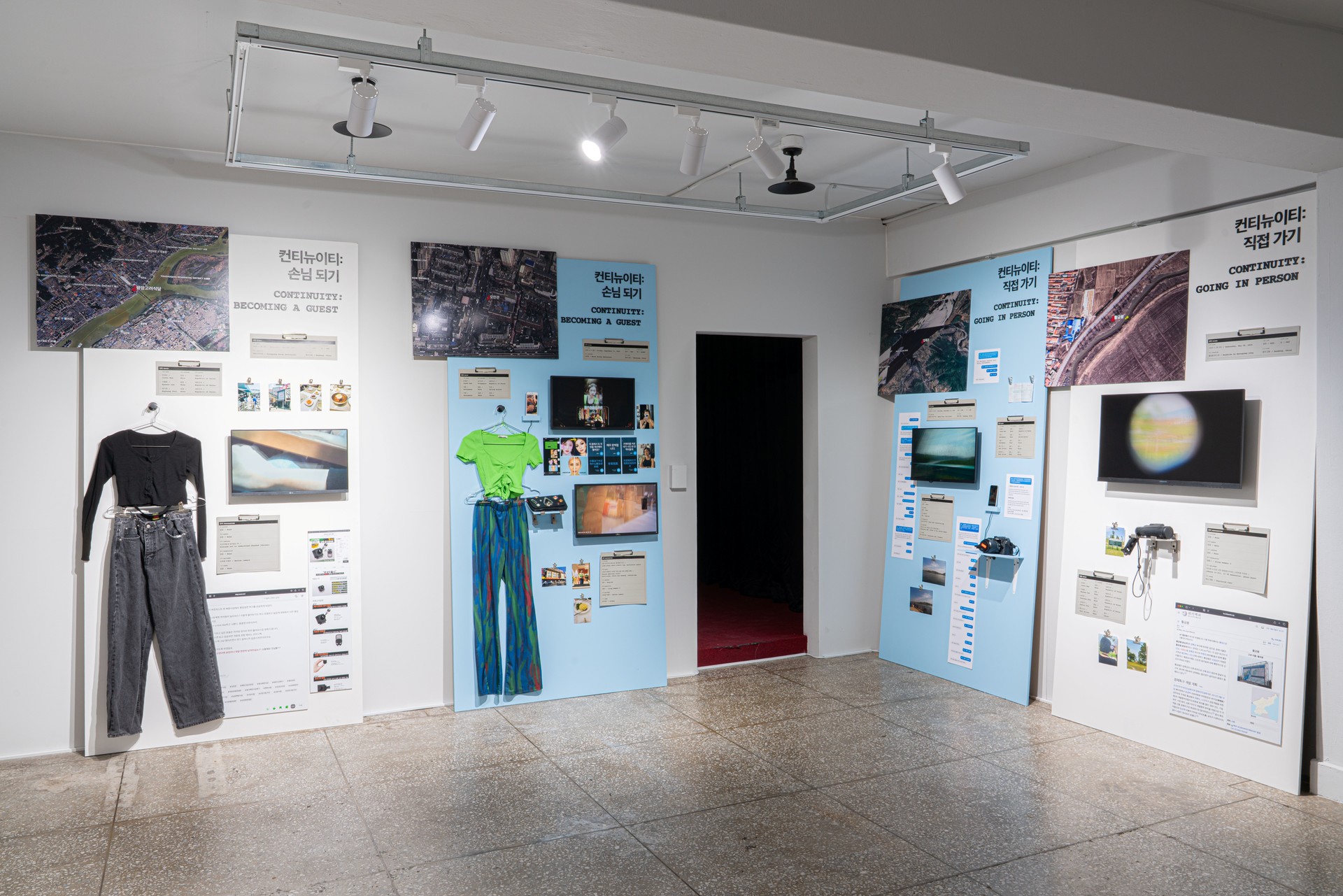
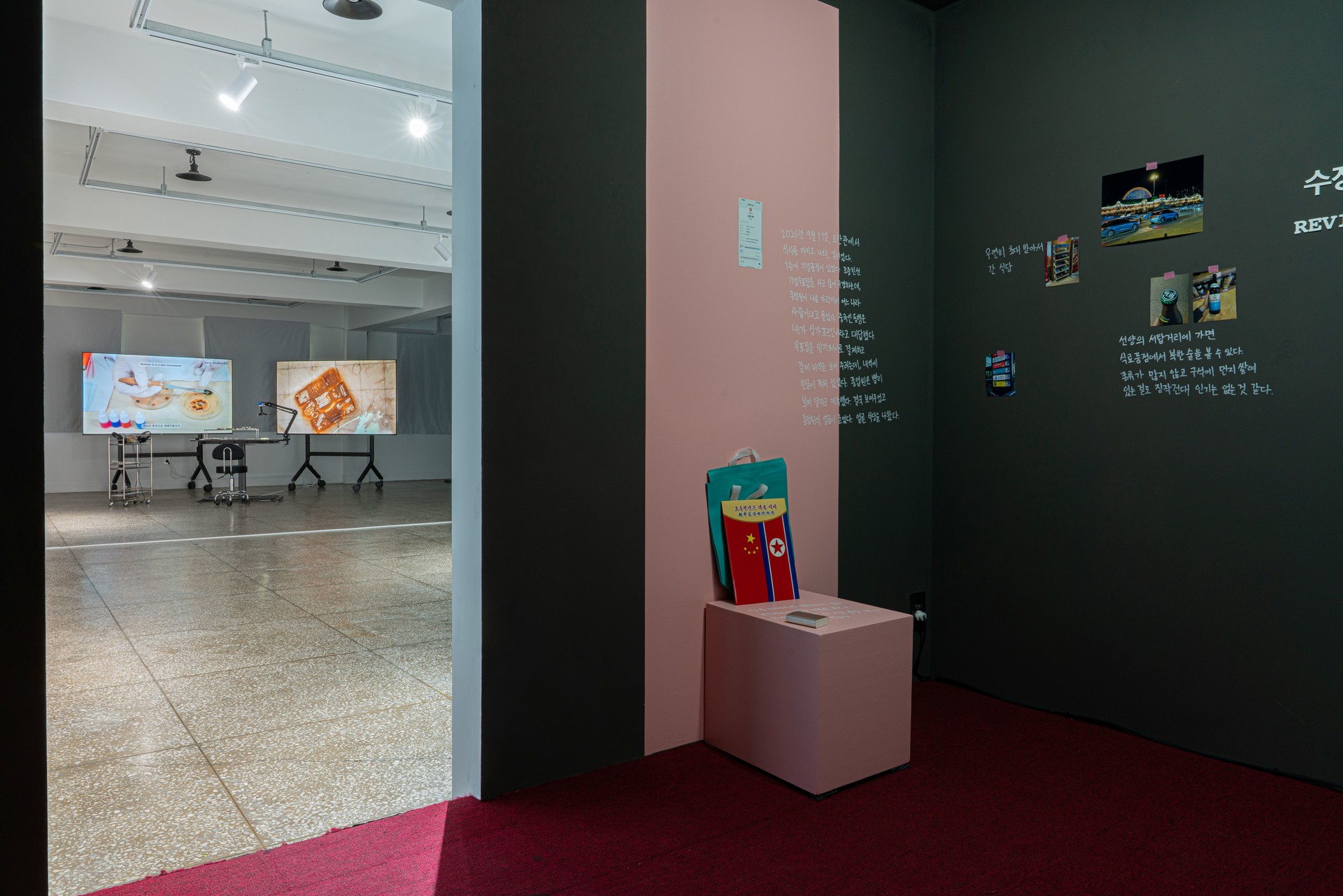
In BAN Jaeha’s Continuity: Becoming a Guest, Going in Person (2026), “continuity” refers to the artist’s continuous, firsthand experiences of approaching North Korea—a place inaccessible to South Koreans—while also serving as the etymological root of “conti” (used in films and comics to maintain scene consistency) and the formal structure of this work. Building on a body of work that has explored the division of the Korean Peninsula and North Korea, BAN Jaeha presents an installation that reconstructs the research trips she undertook last year and this year to the North Korea–China border region.
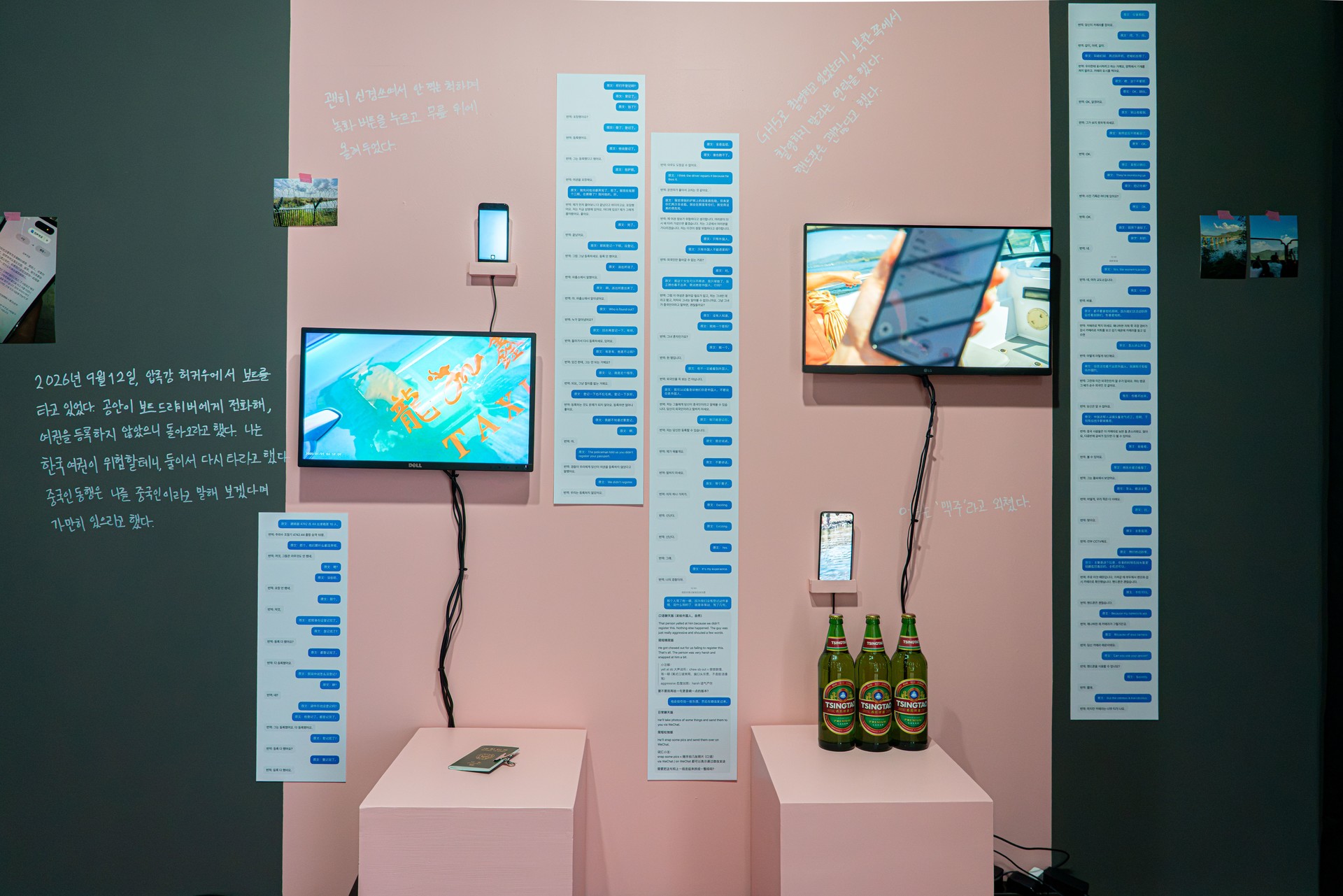
As an attempt to approach the border, the experience of the research trips is composed of two types of actions in this work—“becoming a guest” (visiting a North Korean restaurant) and “going there in person” (visiting the North Korea–China border region)—and is rewritten in the form of a “script.” The artist combines call sheets with the production practice of using different colors for successive script revisions into the process of writing the script, thereby visualizing her performative attempts to physically approach this border. The preliminary research in 2025 and the first visit to the border region constitute the first draft—White; the second visit forms the second draft—Blue; and the subsequent “revisions,” prepared using the next color—Pink—for the next stage of the script.
In fact, to enter a North Korean restaurant where South Koreans are not permitted, she “dressed up” as a foreigner from Singapore. (Perhaps she sought to temporarily alter her identity by changing aspects other than her unalterable nationality.) At one restaurant, she was denied entry because she looked like a South Korean, but the following year, after getting American-style makeup, she was able to eat at a North Korean restaurant. As she moved her body, devised ways to become a guest himself, and approached North Korean soil by boat, what she came to realize was the question of who—or rather, what appearance or nationality—grants one the right to enter a specific place. When you think about it, the “line” of division separating North and South Korea extends beyond legal systems that prohibit travel between the two and impose legal sanctions for propaganda about the other side’s regime; it also permeates the everyday sensibilities through which we recognize and distinguish one another—such as through appearance and cultural codes. In Continuity: Becoming a Guest, Going in Person, we encounter the “line” as a collection of points that suddenly emerge anywhere and under any conditions. The line that divides “us” from “them” is not only a physical line situated at specific coordinates but also the multitude of points that make the line function. She asks: Where are you headed, and what kind of guest will you be there?
When Touching the Wavelength of the Line
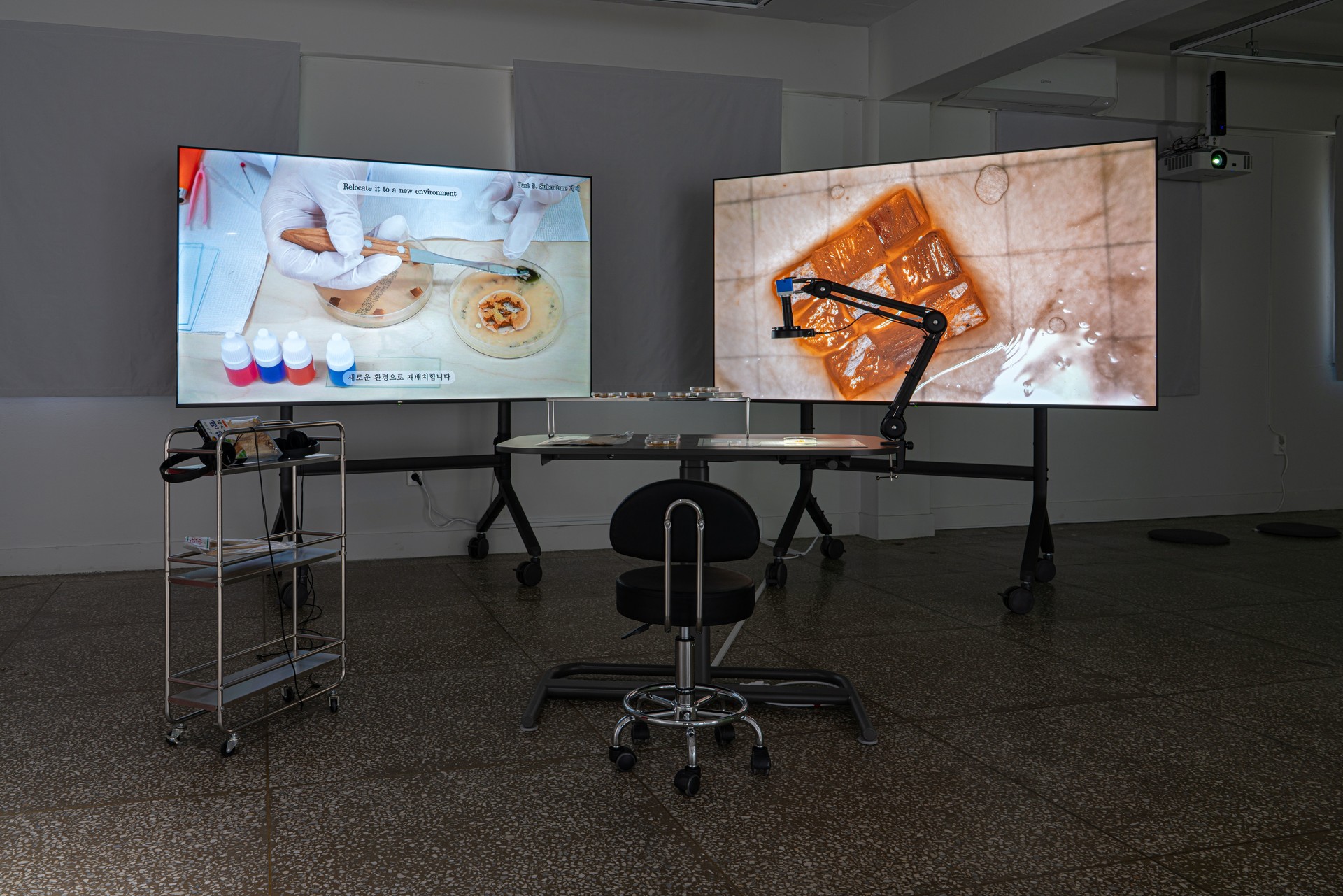
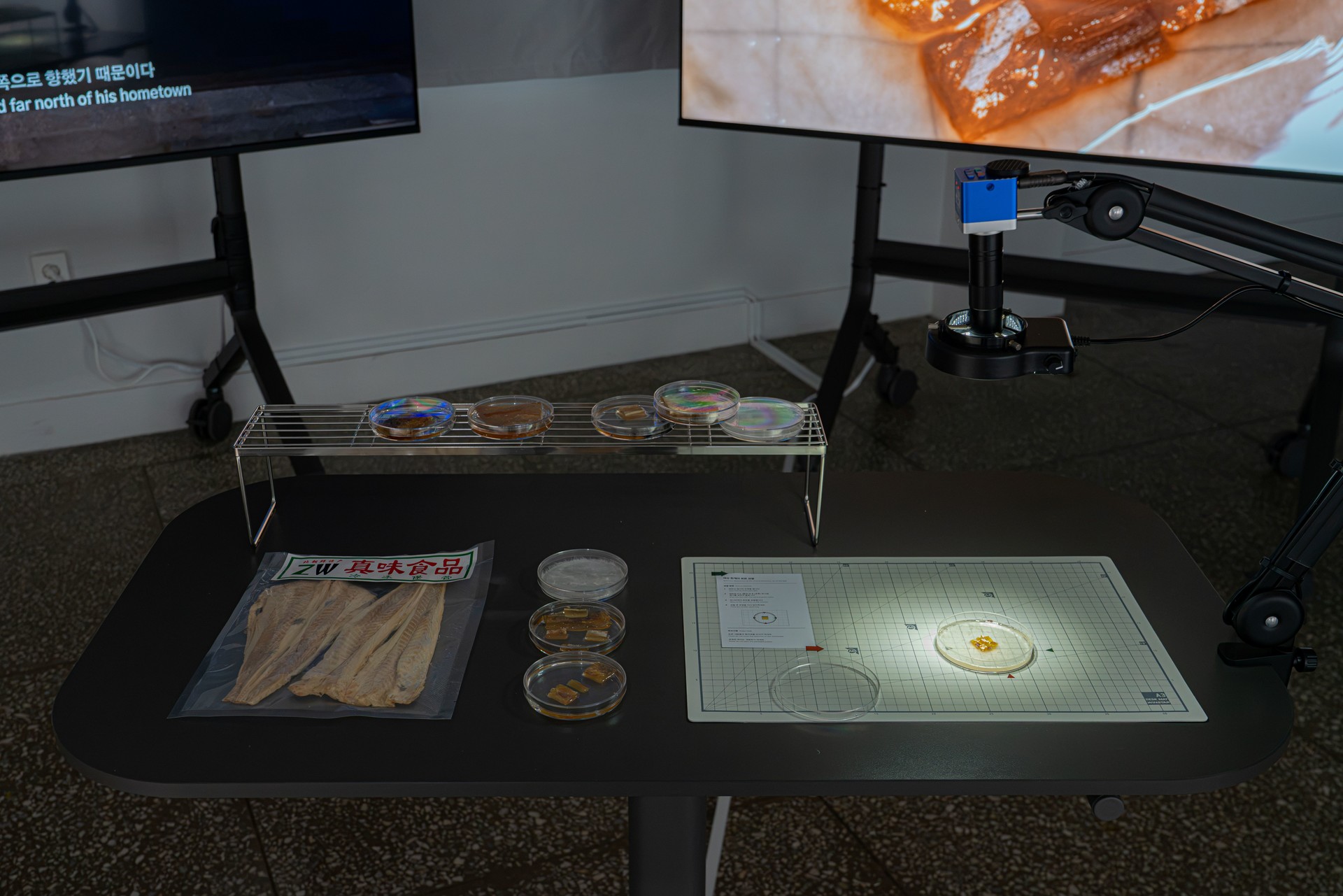
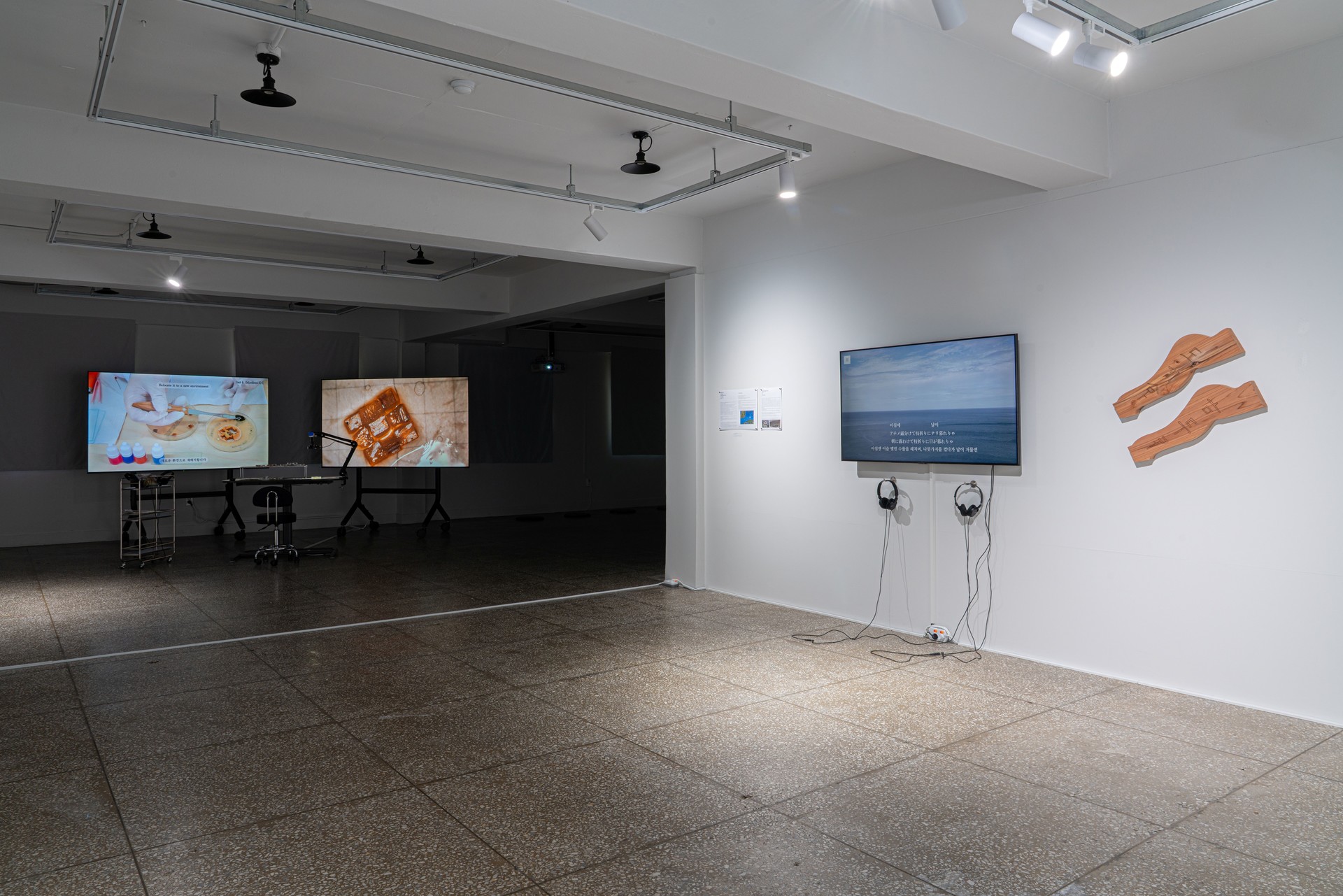
I bring my eye to the microscope. A piece of North Korean pollock, magnified about 150 times by the microscope installed in Specimen Observation at the Limit of Resolution (or of the Sea), enters my field of vision from the monitor. I see what I had not seen before. However, due to the limit of resolution, anything smaller remains invisible. CHOI Kayoung focuses on the word “jeop-an” (接眼; 接岸), which carries dual meanings: the act of bringing one’s eye to a lens and the act of docking a ship at a port. Where can the observing eye dock? We assign origins to marine life that once swam freely in the ocean, and based on that information, we purchase and consume them. During a research trip last year to the former Manchuria region of China, CHOI Kayoung purchased dried pollock labeled “North Korean pollock.” During the rainy season, she happened to notice mold growing on this pollock, which piqued her curiosity.
“Is this mold also from North Korea, did it come from China, or did it develop in South Korea?” To find out, she designed an experiment, cultured the mold colonies on agar plates, and documented the entire process—from research to experimentation—in Colonies in Culture. As the pollock was transported from North Korea to China and then to South Korea, how can one distinguish between what came with it and what attached to it along the way? By tracing this involuntary movement as it passes through various locations, the time and space that were once separated grow closer. At the end of this journey is the artist’s maternal grandmother’s eldest brother, known as “Grandpa Yamamoto.” He traveled from Gyeongsang Province to Japan during the Japanese colonial era to study, conducted research in anatomy at Tohoku University in Sendai, and then boarded a repatriation ship bound for North Korea after the division of the peninsula. This year, the artist visited the university where he had worked to review archives and tasted rice cakes from a long-established shop—ones he might have eaten himself—thereby filling the blank spaces left by what remains inaccessible. The research of her maternal great-uncle—who is said to have examined cell sections under a microscope—and the artist’s act of magnifying and examining a petri dish containing slices of pollock, mold colonies, pigment, and hanji paper overlap across a vast span of time.
However, he left Japan for North Korea long ago and has now become someone she can never meet again. The artist explores the possibility that events from the distant past—of which she was unaware—might be connected to the unease and conflict she experiences here and now. For CHOI Kayoung, the line dividing this from that manifests as ripples that spread from a path someone crossed long ago, reaching into her family’s history and her own life. The artist channels the power and weight of this line—which has reached even her own life—into her work through various forms of inquiry, and proposes to viewers an attitude and methodology for engaging with it by observing and following the traces it has left. Tracing the origin of pollock from North Korea and cultivating mold are acts that connect to the task of tracking the movement of a person whose path cannot be traced and the time that followed. CHOI Kayoung moves through the gaps between things that remain inscrutable even upon close inspection, repeatedly generating new images within them through various methods while retracing those footsteps.
Text by KIM Solji